
DR. JEAN PAUL SUGER -VICERECTOR EJECUTIVO - GALILEO

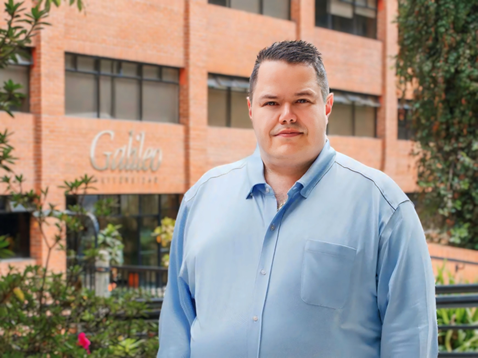
1. Dr. Jean Paul Suger, what is your opinion regarding the educational sector in Guatemala, and what do you believe should be done to further enhance it in the coming years?
Well, thank you very much for the interview. One of the most important things we can emphasize regarding higher education is that it allows us to be more competitive.
At Universidad Galileo, we have always focused on technology and science. We have realized that the greatest developments currently occurring are based on the use of technology and science. We are seeing the beginning of the use of Artificial Intelligence, robotics, and many processes that were previously performed by humans. Today, through technology and science, we are able to create solutions that allow for deeper replication, making company processes more efficient and significantly reducing errors.
I believe higher education in Guatemala has grown tremendously; as you mentioned, there are between 14 and 15 private universities in addition to San Carlos, the national university. Many of us are betting on technology to bridge gaps that we didn't see before. The 2020 pandemic brought the use of online education to the forefront. Thanks to our Rector’s vision, we had been preparing for this type of technology since 2015. For us, it was simply a matter of "flipping a switch" and notifying our students that we were going fully online when the President announced the country would be shut down. We didn't know it would last so long, but we were ready.
This vision has also allowed us to participate in platforms like edX (from Harvard and MIT), where approximately 1.2 million students worldwide have taken Massive Open Online Courses (MOOCs) created by Universidad Galileo. This has given Guatemala exposure as a benchmark for what we can achieve. I feel the country's development will come as we make higher education more accessible. Our mission is to transform lives through education. We must go beyond being considered a purely agricultural country; the talent here is so great that we can compete with countries we used to fear.
We have several examples of industrial projects, such as a Rover created for an energy company. They used to use humans to inspect pipelines; now they use this Rover—a small vehicle that takes photos and measurements. If a pipe collapses, the robot is damaged, but lives are saved. We are also betting heavily on Biomedicine. Under Dr. Andrea Lara, we have an institute researching medical technology. For instance, in rural Guatemala, midwives are still culturally vital. We are creating technological solutions so they can perform pregnancy evaluations using scanners and AI to ensure the baby's growth is within normal parameters.
2. Tell us more about the history of Universidad Galileo. What do you consider to be the greatest achievements or recognitions to date?
Excellent question. Universidad Galileo was born in 1977 as an Institute within Universidad Francisco Marroquín (UFM). In 1982, it became a Faculty, launching Systems Engineering in Guatemala. In 1994, after discussions between our Rector and Dr. Ayau (then Rector of UFM), we took over the open education program and saw massive growth. Realizing our scale and the impact of our philosophy, we sought authorization to become an independent university, which was granted in the year 2000.
Our Rector, inspired by his studies in physics and mathematics at the ETH Zurich, always asked: "Why not use technology and science to advance knowledge?" This has allowed us to grow to nearly 45,000 students. In 2005, we created the Galileo Educational System. Instead of buying external systems like Blackboard, our own engineers developed a platform to manage tasks and communication. This led us to create "Telescopio Galileo" for MOOCs. Being among the first in Latin America to offer MOOCs led to our partnership with edX.
Other achievements include international projects in renewable energy and robotics. We also host the Technological Innovation Forum and the BALAM Robot Competition, where we show young students that engineering isn't a "monster" to be feared. Our teams have competed in the World Robot Competition, earning honorable mentions and proving we are good enough to compete globally. Our graduates are now excelling in Japan, Austria, Brazil, and the U.S. As our motto says, we aim to be the "Revolution in Education."
3. What is your vision for Universidad Galileo in the next five years?
Over the next five years, the goal is to maintain our Rector's vision and "mystique." Often, when leadership changes, the successful formula is lost; I want to ensure we continue projecting into the future.
We will focus on technological applications in medicine and industrial solutions. With the advent of technologies like Starlink, which provides stable satellite internet, we can reach more people. We will also continue supporting "atypical" careers for a tech university—such as Design, Diplomacy, and Aesthetics—because all modern professions require high levels of technological knowledge.
We have already implemented AI chatbots for student services, which allows us to handle large groups efficiently. We want to continue our international expansion and, importantly, fight to obtain more patents and inventions that provide solutions for humanity, not just Guatemala.
4. How relevant is the United States to Universidad Galileo? Are you open to new strategic alliances?
The U.S. is a very important partner. We already host Cisco and Microsoft Academies and have agreements with the University of Michigan and MIT. We are very open to expanding these relationships. The U.S. is the world powerhouse in technology and science, and given the proximity and similar time zones, it is the perfect ally.
We want to move toward synergies that allow for exchanges not just with universities, but with companies. We’ve had experiences where we sent students for internships in the U.S., and the founders hired them immediately because they were so well-prepared. This allows students to fund their own education—a vital component in Guatemala where families make huge sacrifices. We want to bring that "drive" back to our country to form alliances between academia and industry, ensuring our workforce is highly qualified and remains within their companies to foster long-term growth.
5. Dr. Suger, tell us about your personal and professional trajectory.
I studied in Guatemala at the American School and the Colegio Bilingüe de Istermoza. After a couple of years of university in Guatemala, I decided to study abroad. It was a growth experience that showed me the human warmth of world-class industry leaders who teach out of a desire to share knowledge.
I was inspired by the concept of "lifetime employment" seen in places like Japan. At Galileo, our Rector’s right-hand person has worked with him for 60 years. That sense of belonging is vital. Professionally, I returned to Guatemala in 2002 and worked alongside the Rector in Administration and Finance. I spent about 11 years working through various roles before reaching my current position. I like to tell young people: growth isn't always fast. You have to work hard and show your talent. Success isn't achieved alone; it’s a synergy. If you start at the bottom and work your way up, you learn how to avoid errors that could damage the institution.
6. Final message for the influential readers of the L.A. Times: Why come to invest in and get to know Guatemala?
Guatemala presents significant opportunities for investment in higher education and technology due to its stable economy, growing demand for specialized training, expanding tech ecosystem, strategic location, and young talent. Universidad Galileo has a proven track record in technological education, internationalization, and regional leadership, making it an ideal ally for academic cooperation and educational investment.
Would you like me to highlight specific sections of this interview for a summary or a press release?


Comments